Stepping Past the Intuitive: My Journey with Implant Evolution
Direct Answer
Custom surgical guides improve dental implant placement by translating digital 3D treatment plans into physical templates. These guides use sleeves to precisely control the drill's depth, angulation, and position. This eliminates freehand guesswork, protects vital anatomy like nerves, and ensures the implant is optimally positioned for both long-term stability and aesthetic crown restoration.
I remember the early days of my career when dental implant surgery felt more like a master class in manual sculpture than a calculated medical procedure. We relied heavily on our clinical 'gut' and the steady grip of our hands. Back then, if the titanium post integrated with the jawbone, I considered it a win. But as I’ve watched our understanding of facial architecture and oral biomechanics deepen, I’ve realized that the old bar for success was far too low. Today, I don’t just want an implant that stays put; I demand one that functions with biological perfection, looks indistinguishable from a natural tooth, and respects the delicate tissue for a lifetime.
In our practice, we often see patients who are apprehensive about the invasive nature of traditional surgery; however, utilizing surgical guides allows for 'flapless' techniques that significantly preserve the peri-implant soft tissue. This precision not only accelerates initial healing but also prevents common long-term complications like screw-loosening or peri-implantitis caused by improper biomechanical loading from malpositioned implants.
— Clinical Observation

In my practice, I’ve embraced a total departure from 'approximate' dentistry. The shift from clinical intuition to digital certainty is, in my view, the most profound leap in luxury dental care I’ve witnessed. I’ve traded the anxiety of freehand placement for the absolute clarity of data-driven surgery. By merging my years of hands-on experience with high-level software, I can effectively remove human error from the physical act of placement. Every angle, every millimeter of depth, and every prosthetic trajectory is validated by a digital blueprint before I even pick up a handpiece. For my patients, this means the end of the 'unknown' and the beginning of a predictable, high-end experience where results are born from precision, not just optimism.
The Digital Blueprint: How I Craft Your Custom Guide
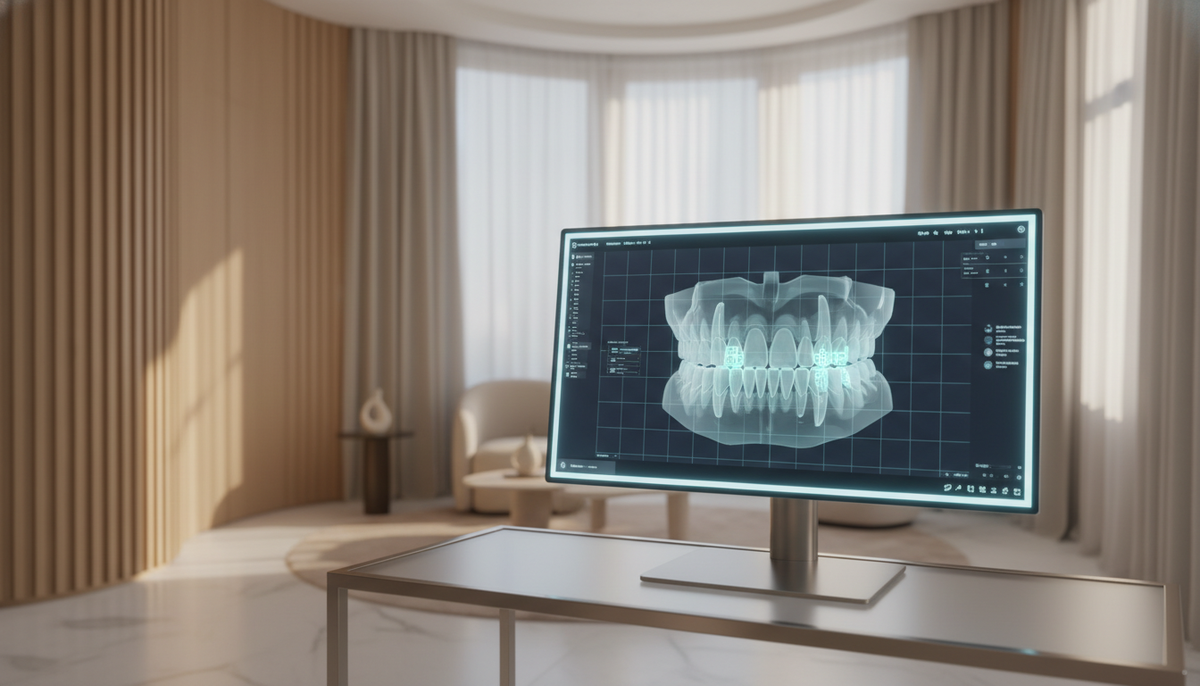
Creating a surgical guide is, to me, a work of bio-engineering art. I start with what I call a 'digital harvest' of your specific anatomy. I use a Cone Beam Computed Tomography (CBCT) scan to capture a high-definition 3D map of your bone, nerves, and sinus cavities. At the same time, I use an intraoral scanner to map the soft tissues and your existing teeth. When I merge these two datasets, I’m looking at a 'digital twin' of your mouth. It’s a virtual sandbox where I can perform and perfect your surgery before you even set foot in my office.

This 'test drive' is where the magic happens. I can rotate your 3D model, poke at the bone density, and test different implant sizes for maximum stability. Once I’ve found the 'sweet spot,' I have a physical tool—the surgical guide—3D-printed to fit your teeth with microscopic accuracy. This tool features sleeves that act as physical limiters, significantly minimizing the risk of instruments deviating from the planned trajectory. It’s the bridge between my digital vision and the physical reality of your smile.
The GPS for Your Smile: Why I Demand Calculated Placement
Navigating the human jaw is a high-stakes game. I’m often working just a hair’s breadth away from the inferior alveolar nerve or the maxillary sinuses. In the old days of freehand surgery, the margin for error was unnervingly thin. I use custom guides because they act as a dental GPS, providing a physical safeguard that prevents me from moving even a fraction of a millimeter into a danger zone. It’s about safety, yes, but it’s also about the physics of your bite.

I’ve seen how sub-millimeter inaccuracies can wreck an implant over time. If I tilt an implant even slightly the wrong way, it creates 'stress points' that lead to bone loss. By ensuring the post sits at a mathematically perfect angle, I’m optimizing how your jaw handles the force of chewing. I often tell my patients: the difference between an implant with a standard prognosis and one optimized for maximum long-term durability. is often found in those tiny, invisible fractions of a millimeter.
A Gentler Touch: How I Minimize Your Trauma
One of the things I love most about guided surgery is the shift toward truly minimally invasive care. In a traditional setting, I would often have to make a large incision and 'flap' the gum back just so I could see what I was doing. That’s what caused the swelling and the long recovery times. But because I have all the data I need from my digital plan, I don’t need that wide-open view anymore.

I often perform what I call 'flapless' surgery. I place the implant through a tiny, precise punch in the gum tissue. This preserves the blood vessels and nerves, which means less bleeding and significantly less pain for you. In my experience, patients often experience a significantly accelerated recovery compared to traditional open-flap procedures. When time is your most precious resource, this technology isn't just a convenience—it's a necessity.
The Aesthetic Advantage: Why I Plan From the Top Down
I believe true aesthetic excellence is achieved through 'reverse engineering.' Historically, dentists put the implant where the bone was thickest and then tried to figure out how to make a tooth fit on top of it. The results were often... less than ideal. You’d end up with teeth that looked 'sunken' or crowns that didn't match the gum line. I do the opposite. I start by digitally designing your perfect final tooth—the one that fits your face and your personality—and then I work backward to find the exact spot the implant needs to be to support it.

- Natural Emergence: The tooth looks like it’s growing out of the gum, not sitting on top of it.
- No Dark Shadows: Precision placement prevents the titanium from showing through thin tissue.
- Symmetry: I can ensure your new tooth perfectly mirrors its natural counterpart.
Risk Mitigation: I’m Protecting Your Investment
I view a dental implant as a major investment in your quality of life. And like any high-stakes investment, I want to mitigate every possible risk. Implants don't usually fail because the body 'rejects' them; they fail because of mechanical stress or improper placement. When I use a guide, I’m virtually eliminating the chance of placing an implant in bone that’s too thin or at an angle that can’t handle the pressure of your bite.
I use the guide to spot complications—like the need for a sinus lift—long before I ever start the procedure. For me, doing it right the first time isn't just about my professional pride; it’s about ensuring that your oral health remains stable for the next thirty or forty years. I want this to be the last time you have to think about this tooth.
What You’ll Experience in My Chair
When you come in for a guided procedure, you’ll notice a different vibe. There’s a sense of calm and organization. Because I’ve already done 90% of the heavy lifting in my digital suite, your time in the chair is cut nearly in half. I’m not guessing or adjusting on the fly; I’m executing a pre-determined, highly efficient plan. It’s intentional, focused, and quiet.
I’ve had many patients tell me that knowing I’m using a bespoke, 3D-printed guide made specifically for their anatomy gives them a massive sense of relief. It’s the difference between a suit off the rack and one that’s been custom-tailored for your specific frame. The fit is better, the feel is more natural, and the confidence it provides is simply unmatched.
Securing Your Future Smile
I truly believe that choosing a provider who utilizes custom digital guides is the smartest health move you can make. It’s my commitment to you that I will use every tool at my disposal—3D imaging, virtual simulations, and robotic-level precision—to ensure your result is flawless. We are living in an age where technology has finally caught up to our highest clinical aspirations. The results I can offer today were simply impossible just a few years ago.
Your smile is your signature. It’s how you greet the world. When it comes to replacing a part of yourself, I don't think 'good enough' should ever be on the table. I invite you to come in and see your digital plan for yourself. Let me show you the future of your smile before we even begin. In my hands, supported by this incredible technology, the path to a perfect smile is clearer and more comfortable than ever.
Frequently Asked Questions
General
What is a custom surgical guide for dental implants?
What is a custom surgical guide for dental implants?
A custom surgical guide is a 3D-printed medical tool created from a digital map of your jaw. It fits over your teeth or gums during surgery to guide the dentist's instruments with microscopic precision, ensuring the implant is placed at the exact angle and depth planned in the digital simulation.
General
Is guided dental implant surgery less painful than traditional methods?
Is guided dental implant surgery less painful than traditional methods?
Yes. Because the surgery is planned digitally, dentists can often use a 'flapless' technique, which requires only a tiny punch in the gum rather than a large incision. This results in significantly less trauma, less bleeding, and a much faster recovery time.
General
How does a surgical guide improve the look of my new tooth?
How does a surgical guide improve the look of my new tooth?
By using 'reverse engineering,' the dentist designs your perfect final tooth first and then uses the guide to place the implant in the ideal position to support that tooth. This ensures a natural emergence from the gum line and better facial symmetry.
Key Takeaways
- Custom guides remove the variability of manual placement by providing a physical 3D-printed roadmap based on a digital twin of your mouth.
- Digital planning allows for 'reverse-engineered' aesthetics, placing the implant based on the ideal tooth position rather than just where bone is present.
- Minimally invasive 'flapless' surgery is often possible with guided tech, leading to reduced swelling, less bleeding, and faster recovery.
- Precise angulation protects vital structures like the inferior alveolar nerve and maxillary sinuses from surgical trauma.
- Calculated placement ensures even distribution of biting forces, which is critical for preventing bone loss and extending the lifespan of the restoration.
Dr. Afshan Pervez
Lead Dental Surgeon & Aesthetician | BDS, RDS, Orthodontist
Dr. Afshan Pervez is the Lead Dental Surgeon & Aesthetician at The Teeth Clinic, bringing over 14 years of international clinical experience. Holding a BDS and RDS with advanced training in Orthodontics, she has completed prestigious programs including an Integrated Masters in Portugal and specialized studies in Implant Dentistry in Hong Kong and the USA. Her diverse expertise spans Surgery, Endodontics, and Aesthetic Medicine, where she blends high-level technical precision with a refined eye for facial aesthetics.
Last clinically reviewed: 05/04/2026