
The Hidden Foundation: Why I Believe Your Back Teeth Are the True Architects of Your Face
Direct Answer
Partial dentures for back teeth are removable dental appliances designed to replace missing molars and premolars. They are essential for restoring chewing efficiency, preventing the migration of remaining teeth, and maintaining the 'vertical dimension' of the face, which prevents the lower face from collapsing and looking prematurely aged.
In my years of clinical practice, I’ve noticed a recurring pattern: patients walk through my doors obsessed with the 'social six'—those front teeth that flash in mirrors and selfies. But I always tell them the same thing: while your front teeth handle the introductions, your back teeth hold your entire face together. Your molars and premolars aren't just chewing tools; they are the biomechanical pillars of your oral health. When these 'silent giants' are lost to time or trauma, the impact isn't just a gap in your mouth—it’s a fundamental shift in your physical identity.
In our practice, we often see patients who delay replacing posterior teeth only to present later with significant 'supra-eruption,' where the opposing teeth drift into the empty space. This migration disrupts the entire bite alignment and complicates future restorative work, highlighting why a well-fitted partial denture is a critical preventive tool for long-term oral stability.
— Clinical Observation

I focus heavily on what we in the industry call the 'vertical dimension.' Think of it as the scaffolding of your lower face. When you lose posterior teeth, your jaw over-closes, and the distance between your nose and chin begins to shrink. I’ve seen it happen dozens of times—the skin pools, the corners of the mouth drop, and 'facial sagging' sets in. While fillers address soft tissue, restoring posterior teeth provides the necessary skeletal support to mitigate age-related structural collapse. When I restore these teeth, I’m not just fixing a bite; I’m reclaiming the structural integrity of your profile.
There’s also the issue of the 'oral vacuum.' Your mouth is a dynamic environment that abhors an empty space. Without a placeholder, I’ve watched healthy teeth tilt, rotate, and migrate like shifting tectonic plates. This chaos disrupts your occlusion—how your teeth meet—and often leads to the chronic headaches and TMJ agony my patients complain about. By choosing a partial denture, I’m essentially giving your mouth a 'peacekeeper' that keeps every tooth in its rightful place.
My Approach to Bespoke Solutions: Crafting Posterior Partials
I don't believe in the clunky, 'one-size-fits-all' appliances of the previous generation. To me, a modern partial denture is more akin to a piece of custom-engineered medical jewelry. When I sit down with a patient at The Teeth Clinic & Aesthetics, we choose materials based on their specific biology and lifestyle.
- Chrome Cobalt: This is my 'gold standard.' Because your back teeth endure immense crushing forces, I often recommend this for its sheer resilience. It allows me to design an incredibly thin, elegant framework that doesn't crowd the tongue but offers a stability that plastic simply cannot match.
- Flexible Partials: For patients who prioritize a 'barely-there' feel, I lean toward high-grade thermoplastics. They have a certain 'memory' and 'bounce' that adapts to your mouth's unique contours. Since they are translucent, they allow your natural gum color to peek through, making them nearly invisible.
- Acrylic Resin: I typically view these as transitional tools. If I’m helping a patient bridge the gap while an implant heals, acrylic is my go-to for its adaptability and cost-effectiveness.

The Precision of the Fit: My Shift to Digital Engineering
I’ll be honest: I’ve never liked the traditional 'goopy' putty impressions. They are uncomfortable for the patient and, frankly, lack the precision I demand. That’s why I’ve transitioned our practice to high-definition digital scanning. I use a handheld wand to create a 3D map of your oral landscape, capturing data points down to the micron.
This digital workflow allows us to 3D-print or mill an appliance that fits like a second skin. If a denture shifts even a fraction of a millimeter while you eat, I consider that a failure. This level of precision ensures that your 'abutment' teeth—the ones holding the denture—aren't under undue stress. My goal is always to protect your remaining natural teeth, ensuring the prosthetic works in harmony with your biology, not against it.

Reclaiming Your Life at the Dinner Table
The most heartbreaking thing I hear from patients is that they’ve stopped ordering what they love at restaurants. When you can’t grind food, you lose more than nutrition; you lose the joy of social dining. When I fit a new partial, I tell my patients to be patient. Your brain needs a 'recalibration' period.
In the beginning, I suggest softer textures—poached fish or well-cooked pasta. A trick I always share is to chew on both sides of the mouth simultaneously. This balances the pressure and prevents the 'seesaw' effect. With proper adaptation, many patients return to a varied diet including tougher foods, though functional capacity remains slightly lower than with natural dentition. It is, quite literally, a transformative experience.

The Aesthetic Secret: Support from the Inside Out
While I prioritize function, I’m also deeply invested in the aesthetics. A common myth is that back dentures are invisible and therefore don't need to look good. I disagree. We use advanced color-matching to mirror the subtle textures, translucency, and gradients of your natural teeth. I don't just pick 'A1 White'; I look for the characterization that makes your smile yours.
Furthermore, these dentures provide critical support to your cheeks. When those back teeth are gone, the face can look hollowed out. My low-profile designs act as a scaffold, gently plumping the cheek tissue from within. The appliance provides internal support to the facial muscles and cheeks, creating a more youthful and supported facial profile. I love it when a patient’s friends tell them they look younger, but can’t quite figure out why. That’s the 'hidden' advantage of posterior restoration.

Maintenance: My Rules for Longevity
I view a high-end partial denture as an investment, and like any investment, it requires care. I tell my patients that their 'daily ritual' is non-negotiable. You must clean the appliance every night with a soft brush. Please, avoid standard toothpaste—it’s far too abrasive and creates micro-scratches where bacteria hide.
More importantly, we need to watch your natural 'anchor' teeth. They are doing extra work now, so their hygiene must be impeccable. I also insist on periodic relining. Your jawbone naturally changes shape over time; every year or two, I may need to add a bit of material to the base to ensure that 'micron-perfect' fit remains intact. A loose denture isn't just annoying—it’s a threat to your remaining bone structure.
Why We Do Things Differently at The Teeth Clinic
At The Teeth Clinic & Aesthetics, I don’t see dental prosthetics as a sign of aging. I see them as a sophisticated tool for maintaining your vitality. My approach is 'lifestyle-first.' I want to know about your habits, your favorite foods, and your concerns before I even pick up a scanner. This isn't just about 'filling gaps'; it's about artisanal engineering.
Restoring your back teeth is, in my opinion, one of the best investments you can make for your future self. Whether it’s the way you speak, the way you eat, or the way you carry your face, these teeth are the foundation. If you’re ready to see how a bespoke solution can change your life, I’m ready to help you design it. Let’s build a smile that is as functional as it is beautiful.
Frequently Asked Questions
General
Why are back teeth important for facial structure?
Why are back teeth important for facial structure?
Back teeth, specifically molars and premolars, act as the 'vertical dimension' or scaffolding of the lower face. Losing them causes the jaw to over-close, leading to facial sagging and a collapsed profile.
General
What are the best materials for posterior partial dentures?
What are the best materials for posterior partial dentures?
Chrome Cobalt is the gold standard for strength and stability. Flexible partials offer a natural feel and appearance, while acrylic resin is often used for transitional or temporary solutions.
General
How do partial dentures prevent TMJ pain?
How do partial dentures prevent TMJ pain?
By filling the gaps left by missing teeth, partial dentures act as a 'peacekeeper,' preventing remaining teeth from shifting and maintaining proper occlusion, which reduces stress on the jaw joint.
General
How should I clean my partial dentures?
How should I clean my partial dentures?
Clean them daily with a soft brush and non-abrasive cleaner. Avoid standard toothpaste as it can create micro-scratches that harbor bacteria.
Key Takeaways
- Back teeth serve as the biomechanical pillars that maintain facial height and structure.
- Unfilled gaps cause neighboring teeth to shift, potentially leading to TMJ disorders and headaches.
- Modern materials like Chrome Cobalt offer superior strength and stability for heavy-duty chewing.
- Digital 3D scanning provides a superior, 'second-skin' fit compared to traditional putty impressions.
- Maintenance requires non-abrasive cleaning and periodic professional relining to accommodate natural jawbone changes.
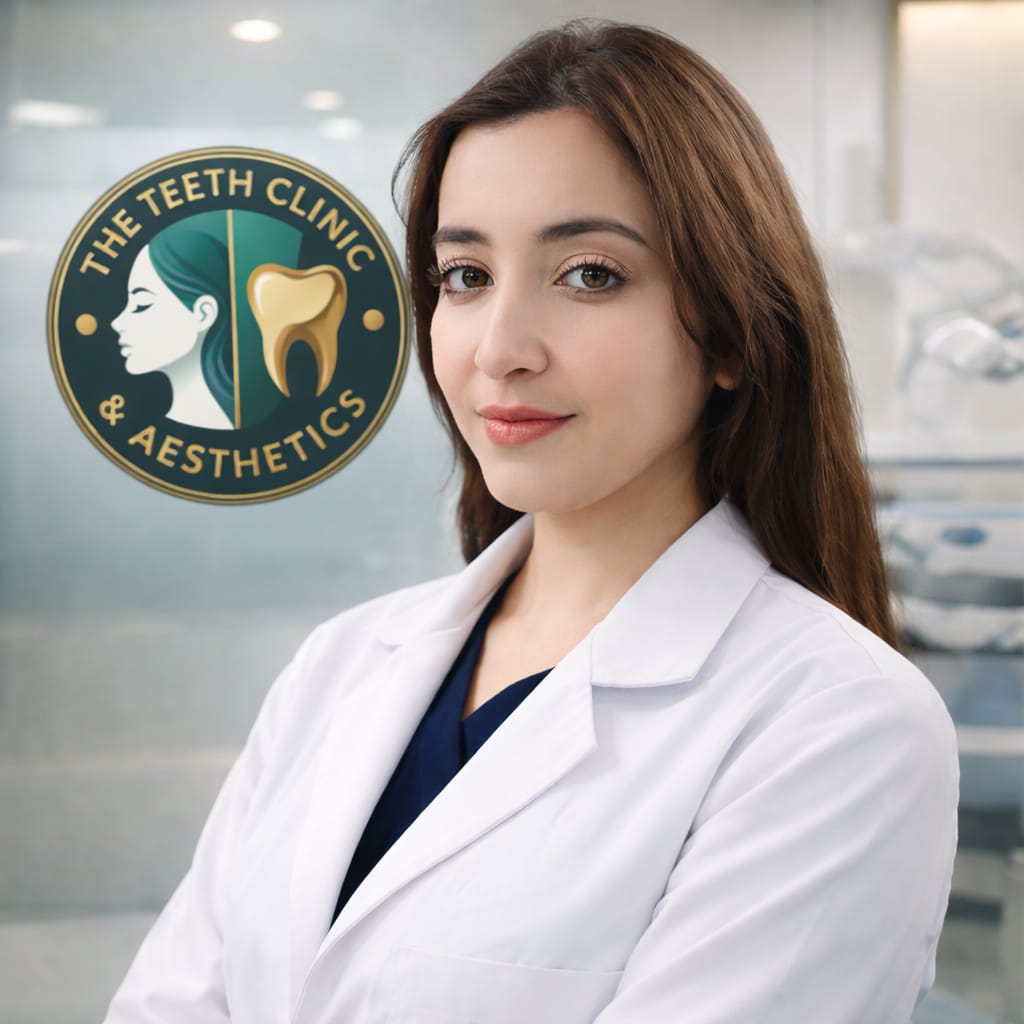
Dr. Afshan Pervez
Lead Dental Surgeon & Aesthetician | BDS, RDS, Orthodontist
Dr. Afshan Pervez is the Lead Dental Surgeon and Aesthetician at The Teeth Clinic & Aesthetics. With over 14 years of clinical experience, she holds BDS and RDS credentials and is a specialist in Orthodontics and Aesthetic Medicine. Her extensive global training includes advanced studies in Integrated Masters in Portugal, Implant Dentistry in Hong Kong, and Global Health in Denmark, alongside specialized dental training in the USA. She focuses on combining surgical precision with aesthetic artistry to deliver bespoke patient care.
Last clinically reviewed: 06/04/2026